
Inside the book
A novel about El Salvador, Bitcoin bonds, and the debt empire
Improbable Coherence is a speculative novel by Mario Cordon set in a near-future world where debt has become the operating system of nations. When an AI-driven power surge blacks out the Northeast Corridor and a Treasury auction falters, a small, indebted Central American nation — El Salvador — takes a different path: hard money to anchor trust, abundant energy, and sovereign compute. Told through the eyes of Dr. Lynette McFadden, a fiscal systems analyst sent to explain why the model should not work, it is a novel about debt, energy, Bitcoin bonds, the IMF, and what becomes possible when a country organizes around coherence instead of dependency.
The story
The story opens in September 2030. During a presidential address about an age of limitless intelligence, the lights go out: an AI data center comes online and its load ramp overwhelms an aging grid. The next morning a routine U.S. Treasury auction refreshes its order book — and the world’s most trusted market reveals what it now costs to be believed.
Far from Washington, a small nation that has spent decades constrained by ledgers rather than armies — dollarized, indebted, and living inside IMF programs — has been assembling a different architecture. Not through rebellion or ideology, but through design: hard money to anchor trust, energy to power growth, compute to accelerate intelligence and coordination.
Dr. Lynette McFadden, a Columbia fiscal systems analyst, is sent to explain why it cannot work. What she finds — Bitcoin bonds whose auctions oversubscribe while Treasury yields widen, small modular reactors and geothermal-Bitcoin hybrid grids feeding compute clusters, a medical zone filling with patients priced out of the U.S. system, a fiscal engine that closes its ledger automatically — forces a choice between the doctrine she was trained in and the evidence in front of her.
Improbable Coherence is a work of fiction. Everything after 2025 is imagined. Public figures and institutions that appear — including a fictionalized President Nayib Bukele and the International Monetary Fund — are used in a narrative and symbolic way; the future depicted has not occurred and is not a forecast, a manifesto, or financial advice.
The world of the book
El Salvador, Bitcoin bonds, the IMF — as fiction
A near-future El Salvador
The novel’s rebel nation is a fictional El Salvador a few years from now. For most of its modern history the country lived on the margins — not conquered by armies but constrained by ledgers: a tiny GDP, a heavy external debt load, a dollarized economy with no printing press and no counter-cyclical levers. In the book, that constraint becomes the reason to design something different.
Bitcoin bonds and the debt empire
The story’s central mechanism is a Bitcoin-linked sovereign bond that finances real infrastructure — energy first, then compute. The novel follows the bonds from auction to outcome, and imagines what happens to a Treasury market built on leverage when a small issuer’s yields compress while its own widen. The empire in the title is not a country; it is debt itself — abstract, borderless, self-reinforcing.
The IMF and the old guardians
For indebted nations, one institution reliably appears at moments of constraint: the International Monetary Fund. The novel treats the IMF as the historical custodian of the debt architecture — “to borrow was to comply” — while its post-2025 institutions and councils are fictional composites created to explore how large systems behave under sustained pressure.
A fictionalized President Bukele
Public figures in the novel, including President Nayib Bukele, are fictionalized characters in an imagined 2030s. Their words and decisions in the book are invented for the story. Improbable Coherence is not reporting, endorsement, or advocacy; it is a thought experiment about coherence, dramatized.
Energy, compute, and the renaissance
Aurora I and II — the novel’s small-modular-reactor energy spines — and geothermal hybrid grids on volcanic flanks turn abundant energy into intelligence and coordination. A medical zone fills with patients priced out of the U.S. system; AI tutoring closes a decades-old learning gap; a fiscal engine closes the nation’s ledger automatically. The final third of the book asks what becomes possible when a once-overlooked nation organizes around sound money, productive infrastructure, and long-term design.
Read the opening pages
Chapter excerpts
01 · Chapter 1
Grid Overload
The system that broke the many.
Washington, D.C. — 9:22 PM, September 2030
President Andrew Whitman stood beneath the chandeliers of the East Room, framed by flags and soft white light.
“America has always led by building,” he said, voice steady — rehearsed, sincere. “We built the rails. We built the highways. We built the digital backbone of the modern world.”
Polite applause.
“And now,” he continued, glancing at the teleprompter, “we enter a new era — an age of intelligence, of light, of limitless—”
The lights flickered. Once. Twice.
A murmur rippled through the room. Then the East Room went dark.
Not dimmed. Not lowered. Gone.
Phones lit up uselessly — then died. The microphones cut. Cameras blinked out. The teleprompter froze mid-word.
“No, sir,” an agent said, his hand pressed to his earpiece. “The grid is failing.”
Emergency lights hesitated — a long, terrible pause — then struggled to life in a dull red glow, caught between two eras: the age of steel and the age of machines demanding more current than the system had ever been built to deliver.
“Sir… an AI data center came online. A massive one. Blue Ridge. The load ramp overwhelmed the grid.”
In the semidarkness, the truth crystallized: America’s technological ambition had outgrown the infrastructure meant to power it.
The United States wasn’t defeated by an adversary. It was defeated by its own obsolete grid.
Excerpt — continue reading in the book
02 · Chapter 4
Debt Is the Battlefield
Where nations prove they can be trusted with borrowed time.
U.S. Treasury Building — 8:56 AM
The marble floors of Treasury had seen panics before — wars, recessions, downgrades — but nothing like this.
The blackout still dominated every screen in the world. Energy analysts blamed aging infrastructure. Tech analysts blamed runaway AI demand. Bond traders blamed Washington.
But everyone agreed on one unsettling truth: the United States had revealed a weakness. And the bond market, merciless as gravity, reacted immediately.
The bond market was not a stock exchange. It was where nations proved — day after day — that they could be trusted with borrowed time.
Where debt was priced, rolled, and renewed. Where obedience carried a price. That price was yield.
When confidence fell, prices fell with it. And when prices fell, yields rose — not by decree, but by arithmetic.
Bonds were not bets on growth. They were wagers on coherence.
Treasury Secretary Miller stood with his senior staff in the Auction Operations Room, facing a wall of screens displaying the order book for the morning’s issuance: $78 billion in 10-year notes.
Not a huge auction. Not a difficult maturity. Not usually. But today, demand looked… wrong.
8:59 AM — The Order Book Refreshes
Foreign buyers: weak. Hedge funds: cautious. Primary dealers: nibbling but not covering. Indirect bid: dangerously low.
And then the line that froze the room:
JAPAN: NO BID YET
Excerpt — continue reading in the book
03 · Chapter 6
The Rebel Republic
How a small nation rethinks everything.
The backstory the world forgot — and the one Lynette never knew she needed.
For most of its modern history, El Salvador lived on the margins.
Not conquered by armies, but constrained by ledgers.
It was small. It was poor. It was dangerous. And for decades it carried a reputation it could never afford and a destiny it never chose.
Parents warned their children not to dream. Ambition flowed north through desert crossings; remittance wires carried survival south.
Domestic opportunity was a rumor. Debt was the reality.
But beneath the headlines and the hopelessness, the deeper truth was this: El Salvador’s greatest enemy was never gangs.
It was mathematics.
A tiny GDP. Sluggish growth. A heavy external debt load. A dollarized economy with no printing press and no counter-cyclical levers.
Every crisis meant borrowing. Every borrowing meant conditions. Every condition meant less room to breathe.
Debt-to-GDP wasn’t just a ratio. It was a constraint — tightening not through force, but through arithmetic.
To borrow was to comply. To comply was to concede degrees of policy flexibility.
Debt was not punishment. It was constraint.
Excerpt — continue reading in the book
04 · Chapter 16
The Projects the Bonds Build
Prosperity, freedom, and what comes next.
San Salvador — Early Morning
The vans rolled out just after sunrise, their tires humming over a stretch of road still curing in places. Warm air drifted in through a cracked window. Lynette rested her notebook on her lap, not writing yet — simply watching.
Bukele’s final instruction from the night before echoed in her mind: “Models prove the math. Reality proves the thesis. Show her the reality.”
And now, she was seeing it.
Cranes turning like slow metronomes. New transmission lines running toward the horizon. Steel frames rising out of districts that had once been written off.
“All of this,” she murmured, “in under eighteen months?”
From the front seat, Jaime shook his head. “Not all of it. And not entirely from the Bitcoin bonds. Some roads were underway years ago. Certain upgrades predate Aurora. But the acceleration…” — his hand drew a small arc through the air — “that’s what the bond unlocked.”
He didn’t sound proud. He sounded analytical — like someone who had watched a system leave one state and enter another.
She wasn’t just observing infrastructure. She was searching for the intersection where Nawat’s curves touched the ground.
And she found it in every direction: Evidence. Throughput. Proof.
The Medical Zone — A Nation Becomes a Clinic
Several buildings still wore scaffolding on their upper floors, but the lower levels were unmistakably alive. Doctors in crisp white coats. AI triage kiosks humming. Robotic carts gliding along magnetic rails.
“Medical tourists?” Lynette asked. “Medical migrants,” Jaime corrected. “People priced out — or timed out — of the U.S. system.”
Excerpt — continue reading in the book
Reader questions
Frequently asked
What is Improbable Coherence about?
Improbable Coherence is a speculative novel about debt, energy, compute, and sovereignty. In a near future where debt has become the environment nations live inside, a small Central American country assembles a different architecture — hard money, abundant energy, and sovereign compute — and the global system built on leverage must decide how to respond. It is a novel of ideas told as a geopolitical thriller.
Is Improbable Coherence about El Salvador?
Yes. The “rebel nation” of the subtitle is a fictional near-future El Salvador — a small, dollarized, historically indebted country that, in the story, breaks away from the logic of endless dependency. The identity is revealed gradually in the book; the early chapters keep it deliberately mysterious.
Does President Bukele appear in the book?
A fictionalized President Nayib Bukele appears as a character in the novel’s imagined 2030s. As the manuscript’s disclaimer states, all events after 2025 are invented and public figures are used in a narrative and symbolic way. The book is fiction, not reporting, endorsement, or political advocacy.
What are the Bitcoin bonds in the novel?
In the story, the nation finances energy and compute infrastructure with Bitcoin-linked sovereign bonds — a fictional mechanism the novel calls structurally accretive bonds. The book dramatizes how such bonds might be priced, auctioned, and tested against a conventional debt-based system. It is a narrative thought experiment, not financial advice.
How does the IMF feature in Improbable Coherence?
The International Monetary Fund appears as the historical lender of last resort whose programs shaped the small nation’s past — “to borrow was to comply.” The novel’s post-2025 institutions, including those that resemble global bodies, are fictional constructs created to explore how large systems behave under structural pressure.
Is Improbable Coherence fiction or nonfiction?
It is fiction — speculative, systems-oriented fiction. The author’s note calls it an invitation to examine how systems behave over time, how incentives compound, and how coherence, once lost, becomes difficult to restore. Nothing in it should be read as a forecast or a policy prescription.
Who is the author of Improbable Coherence?
Mario Cordon, a marketing executive, strategist, and systems thinker whose work explores the intersection of debt, technology, power, and human agency.
Where can I buy Improbable Coherence?
Improbable Coherence — A Rebel Nation’s Breakaway from the Debt Empire is available now on Amazon.
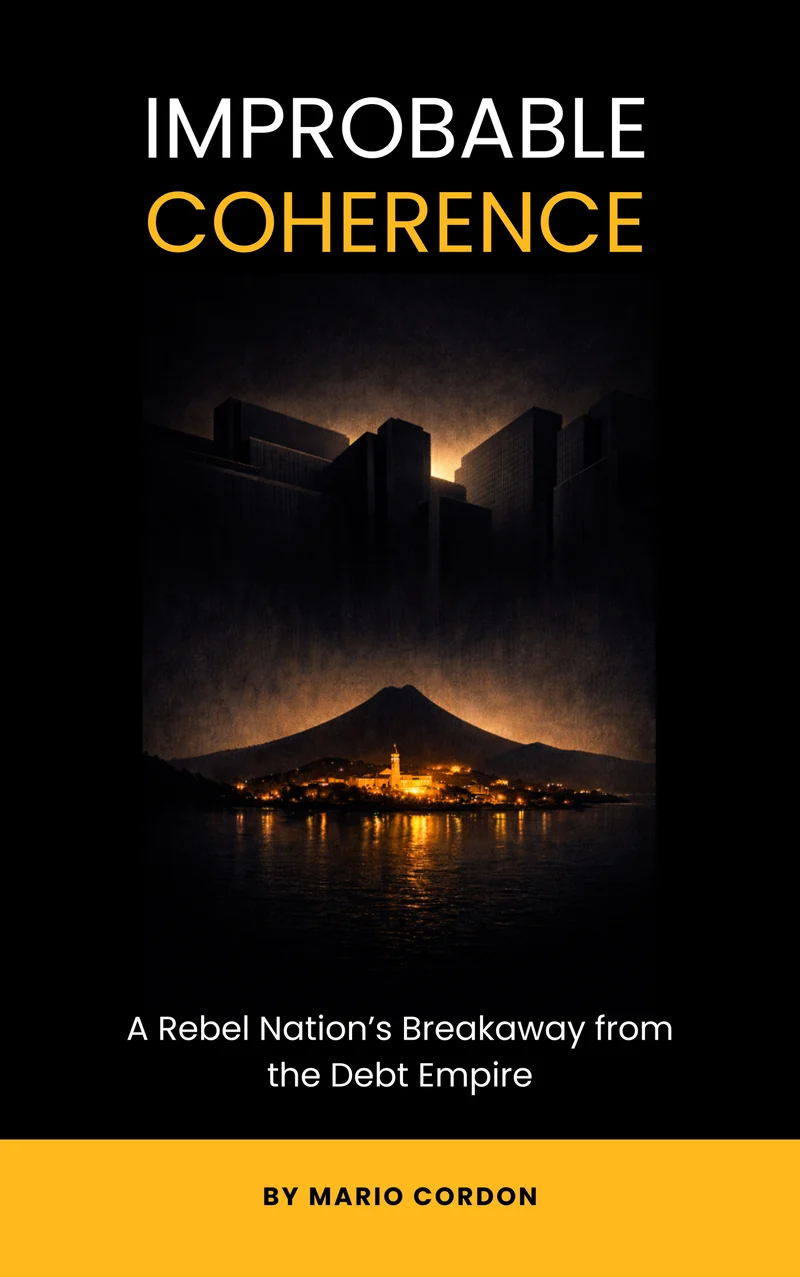
Improbable
Coherence
A Rebel Nation’s Breakaway from the Debt Empire
Get Your CopyAvailable now on Amazon
This book is a work of fiction. All characters, institutions, events, and scenarios are either imagined or used in a fictionalized and symbolic manner. Any resemblance to real persons, organizations, governments, or policies — past or present — is coincidental and unintentional.